
Let’s be honest: decorating a child’s room often feels like a balancing act. You want a space that’s safe, aesthetically pleasing, and reflects their budding personality. But what if that room could be more? What if it could be a launchpad for learning, a sanctuary of discovery, and a constant source of inspiration? That’s the magic of kids room decor with educational themes.
Forget the days of merely choosing a color palette and some cute characters. Today, forward-thinking parents are recognizing the incredible power of their child’s environment to shape their development. From a toddler’s first words to a teenager’s complex equations, the surroundings play a significant, albeit often underestimated, role in fostering curiosity, knowledge acquisition, and a genuine love for learning.
In this comprehensive guide, we’re diving deep into the world of educational room design. We’ll explore how to seamlessly integrate learning into every nook and cranny, creating spaces that are not just beautiful, but profoundly enriching. You’ll discover practical, actionable ideas, real-world examples, and expert tips to craft a room that grows with your child, adapting to their evolving interests and developmental needs. Get ready to transform ordinary bedrooms and playrooms into extraordinary learning landscapes!
By the end of this journey, you’ll have a clear roadmap to:
- Understand the profound impact of environment on a child’s brain development.
- Identify age-appropriate educational themes for infants through teens.
- Implement creative, budget-friendly decor ideas beyond just paint and posters.
- Maximize space and organization for optimal learning and play.
- Cultivate a love for science, history, geography, arts, and literacy, right at home.
The Power of Environment: Why Educational Room Decor Matters
Think about your own favorite study spot or creative sanctuary. Chances are, it’s a place designed to minimize distractions and maximize focus. Children are no different, though their needs are often more fundamental. Their environment isn’t just about focus; it’s about active engagement with the world around them. This is where kids room decor with educational themes shines, transforming passive spaces into active learning zones.
Research in developmental psychology consistently highlights the critical role of a stimulating environment in early childhood brain development. From birth to roughly age five, a child’s brain undergoes rapid wiring, forming billions of connections that lay the groundwork for future learning, emotional regulation, and cognitive abilities. An enriching environment, filled with opportunities for exploration, problem-solving, and sensory engagement, fuels this growth.
Beyond Aesthetics: The Neurological Impact
It’s not just about ‘looking pretty.’ The visual and tactile elements in a child’s room directly influence their neural pathways. For instance, high-contrast images for infants stimulate optic nerve development, while interactive elements like textured playmats or a world map for older children encourage tactile exploration and critical thinking.
A study published by the University of Chicago found that children from print-rich homes demonstrate significantly higher literacy rates and stronger language development. This isn’t necessarily about having a library in their bedroom, but rather the constant, incidental exposure to words, numbers, and symbols that educational decor provides.
Image Suggestion: Infographic showcasing brain development stages vs. environmental stimuli (e.g., “Birth-1 year: Sensory input,” “1-3 years: Language immersion,” “3-5 years: Problem-solving opportunities”).
Fostering Curiosity and Intrinsic Motivation
One of the most potent benefits of themed educational decor is its ability to ignite natural curiosity. When a child’s room is designed around, say, a ‘Space Exploration’ theme, every rocket ship decal, glow-in-the-dark star, or planet mobile becomes a conversation starter. “What’s that planet made of, Mommy?” “How do astronauts breathe in space?” These questions are the bedrock of intrinsic motivation – learning for the sheer joy of discovery, not just for a grade.
This intrinsic motivation is far more powerful and sustainable than external rewards. A child who genuinely loves dinosaurs doesn’t need to be told to read about them; they seek out information naturally. Educational decor creates an ecosystem where such natural curiosity can thrive, making learning feel less like a chore and more like an exciting adventure.
Creating a Consistent Learning Ecosystem
School is structured learning, but home is where much of the foundational, informal learning takes place. When the home environment, particularly a child’s personal space, reinforces educational concepts, it creates a powerful and consistent learning ecosystem. Concepts learned in school can be revisited and solidified through play at home.
Consider a child studying geography in school. If their room features a large world map mural, globes, or animal figures representing different continents, those classroom lessons take on a new, tangible dimension. This consistent exposure helps knowledge ‘stick’ better and provides a multi-sensory approach to learning, catering to different learning styles.
Choosing Your Theme: Age-Appropriate Ideas for Every Stage
The beauty of kids room decor with educational themes is its incredible versatility. What sparks joy and learning in a toddler will differ wildly from what captivates a middle schooler. The trick is to align the theme with your child’s developmental stage, current interests, and future learning goals. Let’s break down some fantastic ideas across different age groups.
Infants & Toddlers (0-3 Years): Sensory Exploration & Early Language
For the littlest learners, the focus is on sensory engagement, language development, and foundational concepts like shapes, colors, and animals. Their world is rapidly expanding, and their room should reflect that wonder.
• High-Contrast & Sensory World
Newborns see in shades of black, white, and red. Decorate with striking high-contrast patterns on walls or mobiles. As they grow, introduce soft textures (a fluffy rug, silky blanket), gentle sounds (wind chime, music box), and safe mirrors for self-discovery.
- Decor Elements: Black and white patterned wallpaper, crinkle fabric books, soft sensory bins (supervised!), large mirrors at floor level, musical mobiles.
- Educational Focus: Visual stimulation, tactile exploration, self-awareness, cause and effect.
• Animal Kingdom Adventure
Animals are universally loved by toddlers and offer endless learning opportunities. Group animals by habitat (forest, ocean, farm), introduce animal sounds, and talk about their characteristics.
- Decor Elements: Wall decals of friendly animals, animal plush toys, animal-shaped storage bins, board books featuring animals, a large, colorful alphabet poster with animal names.
- Educational Focus: Vocabulary (animal names, sounds, habitats), empathy, sorting and categorization.
• Colors, Shapes & Numbers Galore
These foundational concepts can be beautifully integrated. Think a rainbow-themed wall, shape sorters prominently displayed, or a clock with large, easy-to-read numbers.
- Decor Elements: “Color Wheel” wall art, shape-sorting toys, large foam number puzzles, colorful blocks, a clock with labeled numbers.
- Educational Focus: Color recognition, shape identification, basic counting, time awareness.
Image Suggestion: A brightly colored toddler room with a large alphabet rug and animal wall decals.
Preschool & Early Elementary (4-8 Years): Literacy, STEM & Global Awareness
This age group is soaking up information like sponges. They’re learning to read, developing early math skills, and becoming curious about the wider world. Their room can become a mini-classroom disguised as a play haven.
• The Ultimate Reading Nook & Library
Cultivate a love for books! A cozy, inviting reading nook with easy access to books is paramount. Incorporate word walls, alphabet charts, and even magnetic letter boards for interactive spelling.
- Decor Elements: Comfortable bean bag chair or floor cushions, well-lit shelving for books (face-out encourages selection!), alphabet posters, magnetic letter boards, a small whiteboard for practicing writing.
- Educational Focus: Literacy, vocabulary, phonics, storytelling, imagination.
• Space Exploration & Astronomy
The cosmos is endlessly fascinating. From constellations to planets, this theme can spark a lifelong interest in science and mathematics. Think beyond just glow-in-the-dark stars.
- Decor Elements: Planet mobile, solar system mural (wallpaper or hand-painted), constellation map ceiling decals, rocket ship desk lamp, books on space, a small telescope (toy or real), rocket or astronaut figurines.
- Educational Focus: Astronomy, basic physics (gravity), mathematics (distances), scientific inquiry, critical thinking.
• World Traveler & Geography Explorer
Introduce them to the diverse cultures and landscapes of our planet. A large world map poster is a must, but you can go further with cultural artifacts and flags. This theme is brilliant year-round, encouraging children to think big and global.
- Decor Elements: Oversized world map mural or rug, globe, cultural dolls or toys, flags of various countries, books about different cultures/places, animal figures distinct to continents, travel-themed storage boxes.
- Educational Focus: Geography, cultural studies, history, diversity, global awareness.
Tool Recommendation: Large peel-and-stick world map decals are incredibly durable and easy to apply, often featuring animals or landmarks for added educational value. Brands like IKEA or Fathead offer great options.
Upper Elementary & Middle School (9-13 Years): STEM, History & Creative Arts
At these ages, kids are developing more specialized interests. Their rooms should reflect a more sophisticated approach to learning, offering resources for deeper dives into subjects, while still maintaining an element of fun.
• Science Lab & Inventor’s Workshop
Fuel their inner scientist or engineer! Create a dedicated space for experiments, building, and exploration. This theme encourages hands-on learning and problem-solving.
- Decor Elements: Desk with ample workspace, clear storage bins for science kits/building sets (Legos, K’nex), periodic table wall art, scientific instruments (magnifying glass, microscope), chalkboard or whiteboard for brainstorming, ‘invention blueprint’ posters.
- Educational Focus: Chemistry, physics, biology, engineering, problem-solving, critical thinking, experimentation.
• Historical Explorer & Time Traveler
From ancient civilizations to modern marvels, history comes alive in a themed room. Choose a specific era (e.g., Dynastic Egypt, Roman Empire, American Wild West) or a a broad ‘Timeline of History’ approach.
- Decor Elements: Timeline wall mural, framed historical maps, replica artifacts (e.g., pharaoh’s bust, Roman coin), books on historical periods, a ‘famous inventors’ or ‘historical figures’ photo gallery.
- Educational Focus: History, cultural studies, civics, critical analysis of events.
• Artist’s Studio & Creative Arts Hub
For the budding artist, musician, or writer, a room that celebrates creative expression is essential. This encourages self-expression, fine motor skills, and an appreciation for different art forms.
- Decor Elements: Easel, art supply storage, display area for their own creations, musical instrument, sheet music artwork, quotes from famous artists/musicians, a dedicated writing desk with a comfy chair.
- Educational Focus: Art history, music theory, creative writing, aesthetics, fine motor skills, self-expression.
Image Suggestion: A brightly lit room with a dedicated art corner, easel, organized supplies, and framed children’s artwork displayed proudly.
Teenagers (14+ Years): Specialized Studies & Future-Focused
Teenagers crave autonomy and often have specific academic or career interests. Their room decor should reflect these passions, providing a sophisticated, yet stimulating, environment for focused study and continued exploration.
• Collegiate & Career Prep Hub
Help them look forward! This theme focuses on college life, specific career paths, or general academic excellence. It’s about motivation and setting goals.
- Decor Elements: Vision board for future goals, college pennants (if applicable), career-themed artwork, a high-quality study desk and ergonomic chair, smart organization for textbooks, motivational quotes.
- Educational Focus: Career planning, higher education, goal setting, time management.
• Advanced STEM HQ (Coding, Robotics, Engineering)
For the tech-savvy teen, a room that supports their digital exploration or engineering projects. This is about creating a functional, inspiring workspace.
- Decor Elements: Large monitor for coding/design, dedicated workstation for electronics/robotics, storage for components, circuit board art, blueprint posters, books on advanced tech topics.
- Educational Focus: Computer science, engineering, physics, mathematics, problem-solving, innovation.
Beyond Walls: Incorporating Education into Every Element
The beauty of kids room decor with educational themes is that it isn’t just about what you hang on the walls. It’s about thoughtfully integrating learning opportunities into every single element of the room. This holistic approach ensures maximum impact and continuous engagement.
Walls: Murals, Decals & Interactive Surfaces
Walls are your largest canvas. Don’t let them simply hold paint; let them tell a story, display information, or become an interactive learning tool.
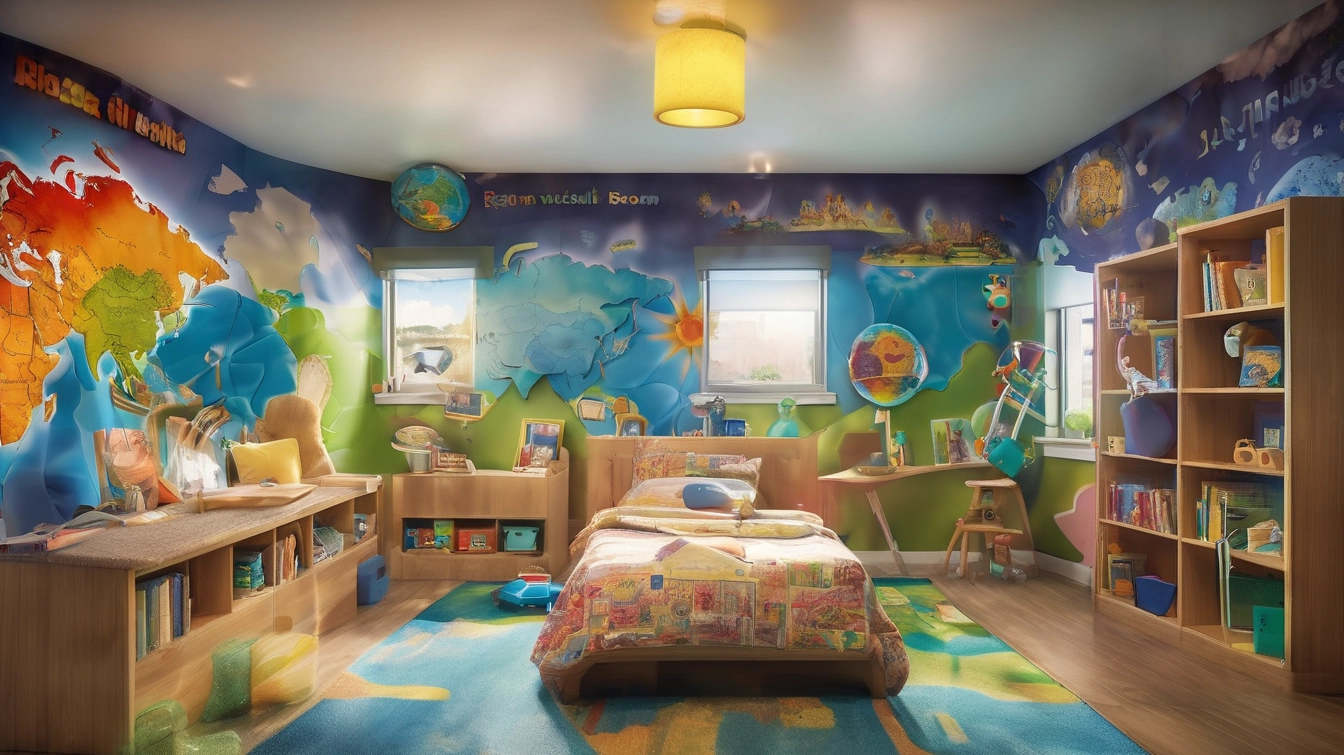
- Murals: A hand-painted mural (e.g., a rainforest ecosystem, a world map, a galaxy) creates an immersive environment. For an easier option, consider large wallpaper murals.
Alt-text suggestion: “Vibrant hand-painted rainforest mural covering a child’s bedroom wall, featuring tropical animals and lush foliage.” - Wall Decals: More flexible and temporary than murals, decals come in every imaginable theme – alphabets, numbers, planets, historical figures, scientific formulas.
Alt-text suggestion: “Assortment of colorful wall decals depicting the solar system planets arranged around a child’s bed.” - Chalkboard/Whiteboard Paint: Designate a wall or a large section of it as an interactive learning surface. Kids can draw, practice writing, solve math problems, or create temporary art. This is fantastic for brainstorming and creative expression.
Alt-text suggestion: “Child drawing on a large chalkboard-painted wall in a playroom, surrounded by art supplies.” - Educational Posters/Prints: Frame high-quality prints of historical timelines, periodic tables, world maps, anatomical charts, famous artworks, or even inspirational quotes from scientists/philosophers.
Flooring: Smart Choices for Play & Learning
The floor is often where the most engaging play happens. Make it count!
- Educational Rugs: Beyond just comfort, rugs can be powerful learning tools. Think alphabet rugs, hopscotch rugs, city street maps, world maps, or even rugs depicting a solar system.
Alt-text suggestion: “Vibrant world map rug covering the floor of a child’s bedroom, with a toy car driving on it.” - Designated Play Zones: Use different flooring types or area rugs to define zones for specific activities – a soft area for reading, a hard-wearing area for building blocks, etc.
Furniture: Form, Function & Ingenuity
Every piece of furniture can serve a dual purpose: practical use and educational encouragement.
- Bookcases & Shelving: Essential for organizing and displaying books. Arrange them by genre, author, or even by topic in an educational theme. Forward-facing book displays are great for younger kids.
Alt-text suggestion: “White bookcase filled with colorful children’s books, many with covers facing outwards.” - Desks & Workspaces: A dedicated study area is vital, especially as children grow. Ensure it’s well-lit, free from clutter, and equipped with age-appropriate tools. Consider a standing desk option for older children.
- Storage: Label bins and drawers with words and pictures. Use clear bins for art supplies or building blocks to encourage easy access and organization by category.
- Bedding: Themed bedding (e.g., constellations, dinosaurs, historical flags) can be a subtle yet constant reinforcement of your chosen educational theme.
Lighting: Illuminating Discovery
Good lighting is crucial for both comfort and learning. Natural light is best, but supplemental lighting can enhance the theme.
- Star Projectors: For a ‘Space Exploration’ theme, a star projector on the ceiling can create a magical, immersive experience perfect for bedtime stories about the cosmos.
- Themed Lamps: A globe lamp, a rocket ship desk lamp, or a light-up terrarium can reinforce your theme.
- Task Lighting: Ensure ample task lighting over desks and reading nooks to prevent eye strain during study or creative work.
DIY & Budget-Friendly Educational Decor Hacks
Transforming a room with educational themes doesn’t require a high-end interior designer or a massive budget. Many of the most impactful ideas are simple, creative, and can be achieved with a DIY approach or smart shopping. Remember, authenticity often resonates more than perfection.
1. Repurpose Household Items
Before you buy new, look around! An old wooden ladder can become a unique book display. Mason jars can store art supplies or science experiment components. Old picture frames can house educational prints.
- Idea: Convert an old dresser into a ‘Science Station’ by painting it a bright color, adding labels to drawers for materials (e.g., “Magnets,” “Test Tubes,” “Nature Finds”), and placing a periodic table on top.
- Benefit: Eco-friendly and cost-effective.
2. Harness the Power of Printables
The internet is a treasure trove of free or low-cost educational printables. Think alphabet/number charts, historical timelines, constellation maps, anatomy diagrams, or world flags. Print them, frame them (even simple clip frames work), or laminate them for durability.
- Where to Find: Educational websites, Pinterest, Etsy (for paid, high-quality designs).
- Tip: Print on cardstock for a more professional look.
3. Chalkboard & Whiteboard Surfaces
We’ve discussed chalkboard/whiteboard paint, but what about smaller, movable options? DIY large framed chalkboards or whiteboards from melamine boards are inexpensive and allow kids to interact with their learning space without committing to a full wall. They’re fantastic for practicing spelling words, drawing diagrams, or daily affirmations.
4. Fabric & Textiles for Thematic Touches
Themed fabric can be bought inexpensively and used for pillowcases, curtains, or even framed as wall art. A plain duvet cover can be transformed with fabric paint and stencils to create a custom educational pattern (e.g., planets, numbers, chemistry symbols).
5. Nature’s Classroom: Bringing the Outdoors In
Nature is the original educator. Incorporate natural elements: pressed leaves, rock collections, shells, small potted plants (child-safe and non-toxic). A clear jar for collecting local bugs (releasing them after observation) can foster early biology skills.
- Idea: Create a ‘Nature Table’ with a rotating display of seasonal items found on walks. Label them and discuss their origins.
- Educational Focus: Biology, botany, geology, observation skills.
6. DIY Display Boards
A simple cork board or string and clothespins can create a dynamic display for your child’s artwork, school projects, or photos related to your educational theme. This celebrates their output and encourages them to share their learning.
Organization as an Educational Tool: Clutter-Free Learning Environments
A beautifully themed, education-rich room can quickly lose its effectiveness if it’s a chaotic mess. Clutter is a major distraction and can hinder both play and learning. On the other hand, an organized space teaches valuable life skills: categorization, responsibility, and the understanding that everything has its place. Kids room decor with educational themes is truly maximized when paired with mindful organization strategies.
The Impact of Clutter on Learning
Imagine trying to focus on a complex problem in a room brimming with unfolded laundry, misplaced books, and scattered toys. Your brain constantly processes these visual distractions, reducing its capacity for deep concentration. For children, especially those with developing attention spans, clutter is even more detrimental.
“An organized physical environment leads to a more organized mental environment. When a child’s space is neat, their thoughts can be clearer, fostering better focus and problem-solving abilities.” – Maria Montessori (paraphrased)
A cluttered room can also stifle creativity. When toys and materials are jumbled, children struggle to find what they need, often resulting in frustration or simply defaulting to the easiest-to-reach, familiar items rather than exploring new possibilities.
Strategies for an Organized Educational Room
1. “A Place for Everything, and Everything in Its Place”
This timeless adage is the cornerstone of effective organization. Every single item in the room, from a small crayon to a large building set, needs a designated home.
- Actionable Step: Involve your child in this process. Ask them, “Where do you think this magnet set should live?” Giving them ownership promotes responsibility.
2. Categorize and Label
Group similar items together. All art supplies go in one bin, all building blocks in another, all science experiment components in a third. Then, crucially, label them.
- Labeling Tips:
- For younger children: Use pictures alongside words (e.g., a picture of a crayon next to the word “Crayons”). This reinforces early literacy.
- For older children: Use clear, concise text labels. They can even create their own stylistic labels.
- Benefit: This makes cleanup easier and helps children learn categorization, sorting, and vocabulary.
3. Utilize Smart Storage Solutions
Invest in storage that is both functional and aesthetically pleasing, aligning with your educational theme where possible.
- Clear Bins: Allow visual identification of contents, reducing the need to rummage. Great for art supplies, small toys, or science kits.
- Bookcases & Shelves: Beyond books, these can hold display items (globes, models), labeled bins, and artistic creations.
- Wall-Mounted Storage: Shelves, pegboards, and wall pockets free up floor space and make items accessible. A pegboard can be a ‘tool wall’ for a science or engineering theme.
- Under-Bed Storage: Perfect for seasonal items or less frequently used large toys.
Alt-text suggestion: “Clear plastic storage bins with colorful labels, neatly organized on a shelf in a child’s playroom.”
4. The “One In, One Out” Rule
As new toys, books, or learning materials enter the room, encourage your child to choose an old item to donate or re-home. This prevents accumulation and teaches about moderation and giving.
5. Regular Decluttering & Maintenance
Organization isn’t a one-time event; it’s an ongoing habit. Schedule a weekly “tidy-up” with your child. Make it a fun, routine activity, perhaps with a timer or a reward system.
- Tip: Start small. Just 10-15 minutes once a week can make a huge difference.
6. Vertical Space is Your Friend
When floor space is limited, look up! Taller bookshelves, wall-mounted storage, and even bunk beds with integrated desks or shelves can dramatically increase usable space without adding clutter.
Integrating Specific Educational Subjects: Deep Dives into Learning Themes
Now that we’ve covered the ‘why’ and the ‘how-to’ of general educational decor, let’s zoom in on how to explicitly weave specific academic subjects into your chosen theme. This level of detail elevates kids room decor with educational themes from merely decorative to profoundly instructional.
1. Cultivating Literary Love: Reading & Language Arts
A love for reading is a cornerstone of all other learning. A room designed to foster literacy actively encourages engagement with words.
- Reading Nook Power-Up: A comfy chair, good lighting, and books displayed attractively are a start. Add a small basket with themed puppets for storytelling, or a ‘story cube’ with prompts for creative writing.
- Interactive Word Walls: Beyond a simple alphabet, create a word wall tied to your room’s theme. If it’s a ‘Jungle Explorer’ room, feature words like “canopy,” “camouflage,” “habitat,” “expedition.”
- Magnetic Poetry/Story Boards: A magnetic wall or board with word tiles allows kids to manipulate language, build sentences, and craft their own stories.
- Literary Quotes: Frame quotes from beloved authors or inspiring figures. For older kids, quotes about the power of words or critical thinking can be evocative.
- Book Collections: Curate books that align with your educational theme. For a ‘World Traveler’ room, include books about different countries, folktales, and dictionaries in various languages.
Image Suggestion: A cozy reading nook with a child snuggled in a beanbag, surrounded by bookshelves and a word-art wall.
2. Unlocking the Universe: Science, Technology, Engineering & Math (STEM)
STEM subjects are increasingly vital. Your child’s room can be their first lab, observatory, or engineering workshop.
- Science Station: A dedicated table or desk with a bin of safe experiment supplies (baking soda, vinegar, food coloring, measuring spoons, clear cups, magnifying glass). Add a poster of the scientific method.
Alt-text suggestion: “Child safely conducting a simple baking soda and vinegar experiment at a dedicated science station in their room.” - Periodic Table of Elements Wall Art: Essential for aspiring chemists. Fun, colorful versions exist for younger learners, while detailed versions suit older kids.
- Anatomy Charts/Skeleton Models: For biology enthusiasts, a human anatomy poster or a small skeleton model provides a hands-on visual.
- Coding Corner: For tech-minded kids, a computer setup with coding games or robotic kits. Decorate with binary code art or circuit board patterns.
- Math Manipulatives Display: Clearly organized shelves with math tools like abacus, counting bears, fraction tiles, or geoboards. A large protractor or ruler wall decal can be fun.
- Constellation/Solar System Projections: As mentioned, these turn a bedroom ceiling into a nighttime planetarium, sparking questions about space.
3. Exploring Our World: Geography & History
Understanding the world – past and present – broadens perspective and fosters global citizenship.
- Interactive World Map: Not just a static map! Choose a peel-and-stick map where children can place pins on places they’ve learned about, or use dry-erase markers to trace journeys. Magnetic maps are also excellent.
- Globes: A physical globe is a must-have. Ideally, one that lights up or has raised relief for tactile exploration.
- Cultural Artifacts & Flags: Display small, safe items from different cultures or flags of countries. This could be a collection from travels or gifts.
- Historical Timeline Wall: Create a visual timeline around the room, from the dinosaurs to modern times, marking key events and figures. This helps contextualize history.
- “Famous Faces” Gallery: Frame pictures of significant historical figures or leaders, scientists, or artists, with a brief blurb about their contributions.
4. Unleashing Creativity: Arts & Music
Art and music foster creativity, emotional intelligence, and cognitive development. Encourage their inner artist or musician directly in their room.
- Art Supply Station: A well-organized cart or drawer for crayons, markers, paints, paper, clay, and craft supplies promotes spontaneous creativity.
- Easel Setup: A dedicated easel encourages painting and drawing. Place it near a window for good light.
- Musical Instrument Display: If your child plays an instrument, display it proudly. This encourages practice and signifies its importance.
- Music Theory Posters: Posters of the musical scale, different instruments, or famous composers.
- Art History Prints: Frame prints of famous artworks from different periods and movements.
Alt-text suggestion: “Gallery wall in a child’s room featuring framed prints of famous impressionist paintings.” - Storytelling Puppets/Props: A small puppet theatre or box of dress-up clothes encourages imaginative play and narrative development.
5. Practical Life Skills & Emotional Intelligence
Beyond academic subjects, a child’s room can also quietly instill practical life skills and emotional awareness.
- Responsibility Charts: A simple, attractive chart with tasks (making bed, putting away toys) helps build routine and responsibility.
- Visual Schedules: Especially helpful for younger children or those with neurodiversity, a visual schedule can outline their day, promoting independence.
- “Feelings” Chart: A gentle poster or display that helps children identify and express their emotions.
- Gardening Corner (Indoor): A small terrarium or a few simple plants (herbs, succulents) can teach responsibility and basic biology.
Addressing Common Challenges & Advanced Strategies
Even with the best intentions, parents often face challenges when implementing kids room decor with educational themes. From budget constraints to evolving interests, here’s how to navigate common hurdles and employ advanced strategies for long-term success.
Challenge 1: Outgrowing Themes Too Quickly
It’s a common fear: spending time and money on a theme only for your child to lose interest in a year. The solution lies in flexibility and foundational elements.
- Strategy: Modular & Layered Design: Instead of permanence, think in layers.
- Foundation: Keep core elements (paint color, large furniture) relatively neutral. A pale blue wall can be ‘sky’ for a space theme, ‘ocean’ for an aquatic theme, or just a calming backdrop.
- Thematic Layers: Introduce the theme with easily changeable elements: decals, bedding, posters, accessories, and removable wallpaper. These are less expensive and easier to swap out.
- Strategy: Broadening Themes: Instead of “Dinosaurs,” go for “Prehistoric World” (allowing for fossils, geography, history). Instead of “Princesses,” try “Storybook Kingdom” (encouraging diverse literature).
- Strategy: Involve the Child: When they help choose, they have more ownership and are less likely to tire of it quickly.
Challenge 2: Budget Constraints
Educational decor doesn’t have to be expensive. Many DIY and smart shopping tactics can make a huge impact.
- Strategy: Prioritize High-Impact Items: A large, engaging wall mural or an educational rug can set the theme powerfully without needing expensive furniture.
- Strategy: DIY is Your Best Friend: As discussed, printables, repurposed items, and chalkboard paint are highly effective and inexpensive.
- Strategy: Source Secondhand: Look for globes, old maps, themed books, or educational toys at thrift stores, garage sales, or online marketplaces. Often, these items have a charming, vintage quality.
- Strategy: Quality Over Quantity: A few well-chosen, durable, and truly educational items are better than a room full of cheap, quickly broken plastic toys.
Challenge 3: Limited Space
Small rooms require smart solutions to maximize learning potential without feeling cramped.
- Strategy: Vertical Storage: Go up! Wall-mounted shelves, tall bookcases, pegboards, and even ceiling-mounted mobiles draw the eye upward and utilize often-wasted space.
- Strategy: Multi-Functional Furniture: A bed with built-in drawers, a desk that folds away, or an ottoman with storage are excellent space-savers.
- Strategy: Fold-Away or Roll-Away Elements: A foldable easel, a roll-away craft cart, or floor cushions that tuck away neatly can transform a small space for various activities.
- Strategy: Mirrors: Strategically placed mirrors can make a small room feel larger and brighter, while also offering educational opportunities for self-awareness in younger children.
Advanced Strategy: Introducing Technology Thoughtfully
While screen time needs managing, technology can enhance an educational room when used strategically.
- Interactive Projectors: Beyond starscapes, some smart projectors can cast educational games or interactive learning apps onto walls or floors, turning the room into a giant tablet.
- Voice Assistants: An age-appropriate voice assistant (like Amazon Kids Echo) can answer questions (“Alexa, how far is the moon?”) providing instant, curated information within the themed environment.
- Augmented Reality (AR) Apps: Some books, maps, and even wall decals now come with AR apps that bring content to life directly in the room via a smartphone or tablet.
Alt-text suggestion: “Child pointing a tablet at a wall decal of a dinosaur, with an augmented reality app making the dinosaur appear 3D on screen.”
Advanced Strategy: Cultivating a Growth Mindset Environment
Beyond specific subjects, design elements can promote a growth mindset – the belief that intelligence and abilities can be developed through dedication and hard work.
- Motivational Quotes: Frame quotes about perseverance, learning from mistakes, and the power of “yet” (e.g., “I don’t know it *yet*”).
- “Work-in-Progress” Display: Instead of just finished art, dedicate a small space to displaying projects that are still being developed, celebrating the process, not just the outcome.
- Celebrating Effort: Praise the effort and strategies used, not just the outcome. Your decor can reflect this by showcasing diagrams of problem-solving steps or a “brave mistakes” board.
Case Study: Maya’s “Under the Sea” Discovery Zone
Let’s look at a real-world example to see how these concepts come together. Meet Maya, a 6-year-old with a boundless curiosity about marine life. Her parents, aiming for kids room decor with educational themes, transformed her bedroom into an “Under the Sea” discovery zone.
The Vision & Initial Setup
Maya loved marine creatures, watched documentaries, and constantly asked about the ocean. Her parents wanted to foster this interest, making her room a sanctuary for oceanic exploration and learning.
- Core Color Palette: Soft blues, greens, and sandy yellows.
- Key Elements (Initial):
- Wall Mural: A large, peel-and-stick mural depicting a coral reef with various fish, gentle sharks, and sea turtles.
- Bedding: Subtly fish-themed duvet cover and jellyfish mobile above her bed.
- Bookcase: Filled with age-appropriate books on marine biology, ocean conservation, and fictional stories set underwater.
- Rug: A plush, deep blue rug resembling the ocean floor.
Image Suggestion: A wide shot of Maya’s bedroom with the coral reef mural, blue rug, and marine-themed bedding.
Integrating Educational Layers
Over time, Maya’s parents layered in more specific educational elements as her interests deepened:
- Species Identification Wall: They added small, laminated cards on a corkboard, each with a picture of a marine animal from her mural, its name, and a fun fact (e.g., “Clownfish – lives in anemones!”). Maya loved matching her toy animals to the cards.
- Ocean Depth Chart: Near her desk, they placed a creative poster illustrating ocean zones (sunlight, twilight, midnight) and the creatures that live in each. This sparked conversations about light, temperature, and adaptation.
- “Oceanographer’s Workbench”: A small, dedicated desk with a magnifying glass, a collection of unique shells (found on family beach trips), a jar for seawater samples (changed weekly), and a small journal for observation drawings.
- Interactive Map: A large world map with a dry-erase surface was added. Maya used it to mark the locations of different oceans and seas and draw the migration paths of various marine animals she was learning about.
- Conservation Corner: They repurposed a small basket for collecting bottle caps and plastic bits, using it to discuss ocean pollution and the importance of recycling. They also displayed posters about marine conservation.
Results & Impact
- Increased Engagement: Maya spent hours in her room, not just playing, but actively learning. She’d narrate stories about different sea creatures, referencing her wall facts.
- Vocabulary Expansion: Her parents noticed a significant increase in her marine-related vocabulary, using terms like “bioluminescence,” “reef,” and “echolocation” correctly.
- Hands-On Learning: The “Oceanographer’s Workbench” encouraged scientific observation and documentation, leading to her first attempts at scientific drawing and journaling.
- Global Awareness: The interactive world map helped her understand geography in relation to marine life, connecting specific animals to specific parts of the world.
- Intrinsic Motivation: Maya’s fascination wasn’t forced; it was nurtured by her environment. Her room became a tangible extension of her passion, making learning feel like an organic part of her day.
Maya’s “Under the Sea” room isn’t just decorated; it’s designed to educate, proving that with thoughtful execution, kids room decor with educational themes can truly inspire young minds.
Tool & Resource Recommendations for Educational Decor
Crafting an educational space for children is an exciting venture. To help you on your journey, here’s a curated list of tools and resources that can make the process easier, more effective, and often, more affordable.
Online Resources for Printables & DIY Ideas
- Pinterest: An endless source of inspiration for DIY projects, free printables, and creative decor ideas for every educational theme imaginable. Search for “educational printables for kids,” “DIY learning walls,” or “[Theme] kids room ideas.”
- Teachers Pay Teachers: While primarily for educators, this site offers a vast array of high-quality, inexpensive academic printables (posters, flashcards, worksheets) that can be incorporated into room decor.
- National Geographic Kids: Offers free maps, animal facts, and photography that can be printed and framed to support geography and biology themes.
- NASA Kids’ Club: Fantastic for space-themed rooms, providing images, facts, and activities related to astronomy and space exploration.
- Free Printable.net / Public Domain Image Sites: Websites offering free vector art, educational charts, or classical artwork (e.g., Met Museum’s public domain art) can be printed in various sizes.
Decor & Furniture Retailers with Educational Focus
- Lovevery / Monti Kids: (For younger children) While not purely decor, their beautifully designed, research-backed play kits and furniture are perfect for creating Montessori-inspired learning environments that promote developmental milestones.
- IKEA: Known for practical, affordable, and often multi-functional children’s furniture and storage solutions. Look for their KURA bed (can be a reading nook fort), TROFAST storage (clear bins for labeling), and LATT children’s furniture.
- Melissa & Doug: Offers a wide range of educational toys, often beautifully crafted from wood, that can double as decor items (e.g., wooden block sets, puzzles, educational charts).
- Fathead / Wall Pops: Specializes in large-format wall decals and wallpaper murals, perfect for creating immersive themed walls quickly and often removably.
- The Land of Nod / Crate & Kids / Pottery Barn Kids: Higher-end options that often feature stylish educational decor, unique themed furniture, and high-quality textiles like educational rugs.
Educational Products That Double as Decor
- Globes: Replogle (classic, high-quality globes), National Geographic (modern, detailed globes). Consider augmented reality globes too.
- Telescopes: Celestron, Orion (for age-appropriate beginner telescopes that look great and are functional).
- Microscopes: AmScope, National Geographic (entry-level microscopes perfect for a science lab theme).
- Building Sets: LEGO (classic bricks, Technic, Architecture series), K’nex, Magna-Tiles (great for spatial reasoning). These are often visually appealing when neatly stored.
- Art Supplies: Faber-Castell, Crayola, Sargent Art (quality supplies that, when organized, look engaging).
Organizational Aids
- Clear Acrylic Bins: muji, The Container Store, IKEA (for visually appealing and functional organization).
- Pegboards: IKEA SKÅDIS, Wall Control (highly versatile for hanging tools, art supplies, or small educational diagrams).
- Label Makers: Dymo, Brother (essential for clear, consistent labeling of storage bins).
When selecting resources, always consider your child’s age, safety, learning style, and your overall budget. Many of the most effective educational decor pieces are those that encourage interaction and engagement rather than simply being passive displays.
FAQ: Kids Room Decor With Educational Themes
What are the best educational themes for a toddler’s room?
For toddlers (agest 1-3), focus on themes that support early sensory engagement, language development, and foundational concepts. Excellent choices include an ‘Animal Kingdom Adventure’ (for vocabulary and sounds), ‘Colors, Shapes & Numbers Galore’ (for recognition), or a ‘Sensory Exploration’ theme using high-contrast patterns and varied textures. Prioritize safety, durability, and items that encourage hands-on interaction and simple categorization.
How can I incorporate educational decor into a small kids’ room?
When space is limited, go vertical! Utilize wall-mounted shelves, pegboards, and tall bookcases. Consider multi-functional furniture like a bed with integrated drawers or a desk that folds away. Wall decals and murals are great as they use no floor space. Keep items organized with clear, labeled bins and maintain a clutter-free environment to maximize the perceived and functional space. Vertical storage not only saves space but also draws the eye upward, making the room feel larger.
Is it possible to create an educational room on a tight budget?
Absolutely! Budget-friendly educational decor is very achievable. Prioritize DIY projects such as creating your own educational printables, using chalkboard or whiteboard paint sections, and repurposing existing furniture. Look for inexpensive wall decals instead of expensive artwork. Thrift stores, garage sales, and online marketplaces are fantastic sources for used books, globes, and educational toys. Focus on a few high-impact elements like a large map or a thematic rug, and gradually build up your decor.
How do I ensure the educational theme grows with my child?
To create a room that evolves with your child, adopt a modular and layered design approach. Keep foundational elements (neutral paint, large furniture) versatile. Introduce your educational theme through easily changeable elements like wall decals, posters, bedding, and accessories. As interests shift, these layers can be swapped out cost-effectively. Broaden themes (e.g., ‘Prehistoric World’ instead of just ‘Dinosaurs’) to make them more adaptable to growing knowledge and complexity. Involving your child in the decor choices also fosters ownership and longevity.
What are some ways to integrate STEM learning into room decor?
STEM integration can be dynamic. For science, create a ‘Science Station’ with a dedicated desk, clear bins for simple experiment tools, and a periodic table wall art. For technology and engineering, consider a coding corner with binary code art or a pegboard tool wall for robotics. Math can be subtly woven in with an abacus, math manipulatives display, or a large, fun ruler decal. Interactive elements like constellation projectors or augmented reality apps tied to STEM subjects also make learning engaging and fun.
How important is organization in an educational room?
Organization is paramount in an educational room. A cluttered environment is a constant source of distraction, hindering focus and creativity for children. Implementing clear categorization, labeled storage (using both words and pictures for younger kids), and a designated ‘home’ for every item helps children learn valuable life skills like sorting, responsibility, and independent cleanup. An organized space allows learning tools to be easily accessible and inviting, maximizing the impact of your educational decor.
Conclusion: Your Child’s Next Adventure Awaits
You’ve journeyed through the incredible potential of kids room decor with educational themes, understanding that a child’s environment is far more than just four walls and a ceiling. It’s a powerful, silent teacher, a constant source of inspiration, and a playground for the mind. We’ve explored how a thoughtfully designed space can ignite curiosity, foster a lifelong love for learning, and contribute significantly to cognitive and emotional development from infancy through the teenage years.
From the early sensory stimulation of a high-contrast nursery to the advanced STEM hub of a teenager’s study space, the thread remains constant: empowerment through environment. Remember that the goal isn’t just a beautifully decorated room, but a beautifully enriched life. By aligning decor with developmental stages, leveraging creative and budget-friendly solutions, and prioritizing organization, you are crafting more than a room; you are building a foundation for future explorers, scientists, artists, and thinkers.
Don’t feel overwhelmed. Start small. Perhaps it’s a themed wall decal, a new educational rug, or simply curating their existing book collection. Involve your child in the process, let their interests guide your choices, and watch their enthusiasm for learning flourish.
Ready to transform your child’s space into a personalized learning adventure?
We encourage you to explore our other guides on Montessori playroom essentials or strategies for developing cognitive skills in children for more insights on nurturing young minds. The journey of discovery begins at home.
Start Designing Your Educational Kids Room Today!
Content Disclaimer
The information provided in this article regarding kids room decor with educational themes is for general informational and educational purposes only. It is not intended to be a substitute for professional advice from child development specialists, interior designers, or educators. Always consult with relevant professionals regarding specific concerns about your child’s development, safety in their environment, or decor choices. While we strive for accuracy, individual results and suitability of recommendations may vary. Any product recommendations are based on general research and not exhaustive endorsements.
Categories
- Accent Walls & Ceilings (84)
- Art Curation & Gallery (83)
- Bedding Style Trends (89)
- Bedroom Makeover (96)
- Bohemian & Eclectic Styles (80)
- DIY & Budget-Friendly Decor (78)
- Eco-Friendly Design (83)
- Furniture Care (87)
- Home Decor & Design Ideas (181)
- Home Wellness Spaces (103)
- Integrated Outdoor Living (91)
- Japandi Style (84)
- Kids and Nursery Decor (73)
- Living Room Decor (99)
- Mix & Match Techniques (95)
- Modern & Contemporary Design (88)
- Rug Sizing & Placement (89)
- Scandinavian Design Inspiration (51)
- Seasonal Home Decor (100)
- Small Space Solutions (93)
- Wall Art & Painting Tips (94)
Recent Comments
Archives
Product Gallery
-
 Majestic African Wildlife Canvas Art for Stylish Home Decor
Rated 5.00 out of 5
Majestic African Wildlife Canvas Art for Stylish Home Decor
Rated 5.00 out of 5 -
 Cozy Irregular Green Plush Rug for Nordic Living Spaces
Rated 5.00 out of 5$33.00 – $203.00Price range: $33.00 through $203.00
Cozy Irregular Green Plush Rug for Nordic Living Spaces
Rated 5.00 out of 5$33.00 – $203.00Price range: $33.00 through $203.00 -
 Scandinavian Geometric Area Rugs for Stylish Home Décor
Rated 5.00 out of 5$25.00 – $365.00Price range: $25.00 through $365.00
Scandinavian Geometric Area Rugs for Stylish Home Décor
Rated 5.00 out of 5$25.00 – $365.00Price range: $25.00 through $365.00